- Gen 23:1-25:18
- 1Ki 1:1-1:31
- Mat 1:1-17
Chayei Sarah means “life of Sarah.” In this week’s reading, we say farewell to Sarah, who lived a full life having seen the miraculous birth of a son in her old age.
| Berĕshith (Genesis) 23:1-25:18 |
The Three Visitors
Berĕshith Chapter 23
1Now Sarah lived to be 127 years old. 2 She died in Qiryath Arba (that is, Ḥeḇron) in the land of Kena‛an, and Aḇraham went out to mourn and to weep for her.
3 Then Aḇraham got up from beside his dead wife and said to the sons of Ḥěth, 4 “I am a foreigner and an outsider among you. Give me a burial site among you so that I can bury my dead.”
5 The sons of Ḥěth replied to Aḇraham, 6 “Listen to us, my master. You are Alahym’s chosen one among us. Bury your dead in the finest of our tombs. None of us will withhold his tomb for burying your dead.”
7 Then Aḇraham rose and bowed down before the people of the land, the sons of Ḥěth. 8 “If you are willing for me to bury my dead,” he said to them, “listen to me, and approach Ephron son of Zohar on my behalf 9 to sell me the cave of Maḵpělah that belongs to him; it is at the end of his field. Let him sell it to me in your presence for full price, so that I may have a burial site.”
10 Now Ephron was dwelling among the sons of Heth. So in the presence of all the sons of Ḥěth who had come to the gate of his city, Ephron the Ḥittite answered Aḇraham, 11 “No, my master. Listen to me. I give you the field, and I give you the cave that is in it. I give it to you in the presence of my people. Bury your dead.”
12 Again Aḇraham bowed down before the people of the land 13 and said to Ephron in their presence, “If you will please listen to me, I will pay you the price of the field. Accept it from me, so that I may bury my dead there.”
14 Ephron answered Aḇraham, 15 “Listen to me, my master. The land is worth four hundred shekels of silver, but what is that between you and me? Bury your dead.”
16 Aḇraham agreed to Ephron’s terms and weighed out for him the price he had named in the hearing of the Ḥittite: four hundred shekels of silver, according to the standard of the merchants.
17 So Ephron’s field at Maḵpělah near Mamrě, the cave that was in it, and all the trees within the boundaries of the field were deeded over 18 to Aḇraham’s possession in the presence of all the Ḥittites who had come to the gate of his city. 19 After this, Aḇraham buried his wife Sarah in the cave of the field at Maḵpělah near Mamrě (that is, Mamrě) in the land of Mamrě. 20 So the field and its cave were deeded by the sons of Ḥěth to Aḇraham as a burial site.
A Wife for Yitsḥaq
Berĕshith Chapter 24
1By now Aḇraham was old and well along in years, and 𐤉𐤄𐤅𐤄 had blessed him in every way. 2 So Aḇraham instructed the chief servant of his household, who managed all he owned, “Place your hand under my thigh, 3 and I will have you swear by 𐤉𐤄𐤅𐤄, the Alahym of heaven and the Alahym of earth, that you will not take a wife for my son from the daughters of the Kena‛anites among whom I am dwelling, 4 but will go to my country and my kindred to take a wife for my son Yitsḥaq.”
5 The servant asked him, “What if the woman is unwilling to follow me to this land? Shall I then take your son back to the land from which you came?”
6 Aḇraham replied, “Make sure that you do not take my son back there. 7 𐤉𐤄𐤅𐤄, the Alahym of heaven, who brought me from my father’s house and my native land, who spoke to me and promised me on oath, saying, ‘To your offspring I will give this land’—He will send His messenger before you so that you can take a wife for my son from there. 8 And if the woman is unwilling to follow you, then you are released from this oath of mine. Only do not take my son back there.”
9 So the servant placed his hand under the thigh of his master Aḇraham and swore an oath to him concerning this matter.
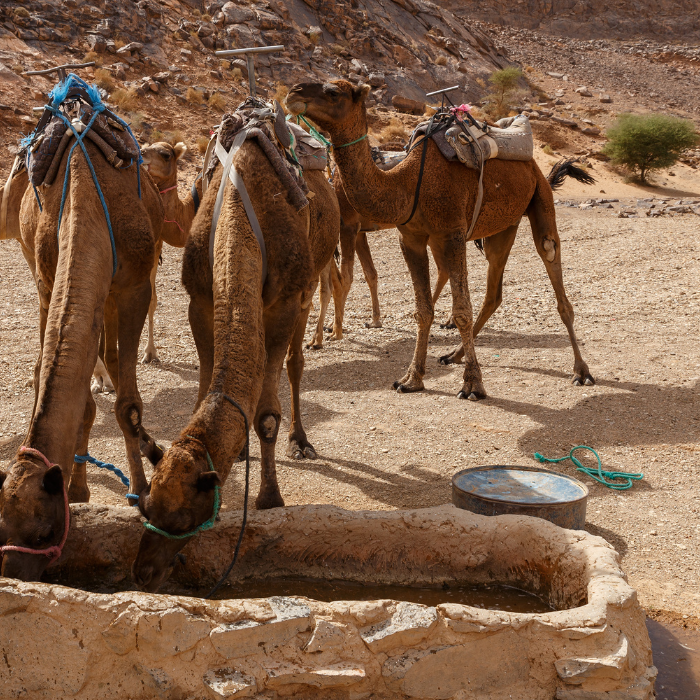
10 Then the servant took ten of his master’s camels and departed with all manner of good things from his master in hand. And he set out for the city of Naḥor in Aram Naharayim. 11 As evening approached, he made the camels kneel down near the well outside the town at the time when the women went out to draw water.
12 “O 𐤉𐤄𐤅𐤄, Alahym of my master Abraham,” he prayed, “please grant me success today, and show loving-commitment to my master Abraham. 13 Here I am, standing beside the spring, and the daughters of the men of the city are coming out to draw water. 14 Now may it happen that the young woman to whom I say, ‘Please let down your jar that I may drink,’ and who responds, ‘Drink, and I will water your camels as well’—let her be the one You have appointed for Your servant of the men of the city. By this I will know that You have shown kindness to my master.”
Riḇqah is Chosen
15 Before the servant had finished praying, Riḇqah came out with her jar on her shoulder. She was the daughter of Bethu’ěl, son of Milkah, the wife of Naḥor, Aḇraham’s brother. 16 Now the girl was very beautiful, a maiden who had not had relations with any man. She went down to the spring, filled her jar, and came up again.
17 So the servant ran to meet her and said, “Please let me have a little water from your jar.”
18 “Drink, my master,” she replied, and she quickly lowered her jar to her hands and gave him a drink.
19 After she had given him a drink, she said, “I will also draw water for your camels, until they have had enough to drink.” 20 And she quickly emptied her jar into the trough and ran back to the well to draw water, until she had drawn water for all his camels.
21 Meanwhile, the man watched her silently to see whether or not 𐤉𐤄𐤅𐤄 had made his journey a success.
22 And after the camels had finished drinking, he took out a gold ring weighing a beka1, and two gold bracelets for her wrists weighing ten sheqels. 23 “Whose daughter are you?” he asked. “Please tell me, is there room in your father’s house for us to spend the night?”
24 She replied, “I am the daughter of Bethu’ěl, the son that Milkah bore to Naḥor.” 25Then she added, “We have plenty of straw and feed, as well as a place for you to spend the night.”
26 Then the man bowed down and worshiped 𐤉𐤄𐤅𐤄 [YAHUAH] 27saying, “Blessed be 𐤉𐤄𐤅𐤄, the Alahym of my master Aḇraham, who has not withheld His loving-commitment and truth from my master. As for me, 𐤉𐤄𐤅𐤄 has led me on the journey to the house of my master’s relatives.”
28 The girl ran and told her mother’s household about these things. 29 Now Riḇqah had a brother named Laḇan, and he rushed out to the man at the fountain. 30 As soon as he saw the ring, and the bracelets on his sister’s wrists, and heard Riḇqah’s words, “The man said this to me,” he went and found the man standing by the camels near the spring.
31 “Come, you who are blessed by 𐤉𐤄𐤅𐤄,” said Laḇan. “Why are you standing out here? I have prepared the house and a place for the camels.” 32 So the man came to the house, and the camels were unloaded. Straw and feed were brought to the camels, and water to wash his feet and the feet of his companions.
33 Then a meal was set before the man, but he said, “I will not eat until I have told you what I came to say.”
So Laḇan said, “Please speak.”
34 “I am Abraham’s servant,” he replied. 35 “𐤉𐤄𐤅𐤄 has greatly blessed my master, and he has become rich. He has given him sheep and cattle, silver and gold, male and female servants, camels and donkeys. 36 My master’s wife Sarah has borne him a son in her old age, and my master has given him everything he owns.
37 My master made me swear an oath and said, ‘You shall not take a wife for my son from the daughters of the Kena‛anites in whose land I dwell, 38 but you shall go to my father’s house and to my kindred to take a wife for my son.’
39 Then I asked my master, ‘What if the woman will not come back with me?’
40 And he told me, ‘𐤉𐤄𐤅𐤄, before whom I have walked, will send His messenger with you and make your journey a success, so that you may take a wife for my son from my kindred and from my father’s house. 41 And when you go to my kindred, if they refuse to give her to you, then you will be released from my oath.’
42 So when I came to the fountain today, I prayed: O 𐤉𐤄𐤅𐤄, Alahym of my master Abraham, if only You would make my journey a success! 43 Here I am, standing beside this spring. Now if a maiden comes out to draw water and I say to her, ‘Please let me drink a little water from your jar,’ 44 and she replies, ‘Drink, and I will draw water for your camels as well,’ may she be the woman 𐤉𐤄𐤅𐤄 has appointed for my master’s son.
45 And before I had finished praying in my heart, there was Riḇqah coming out with her jar on her shoulder, and she went down to the spring and drew water. So I said to her, ‘Please give me a drink.’
46 She quickly lowered her jar from her shoulder and said, ‘Drink, and I will water your camels as well.’ So I drank, and she also watered the camels.
47 Then I asked her, ‘Whose daughter are you?’
She replied, ‘The daughter of Bethu’ěl son of Naḥor, whom Milkah bore to him.’ So I put the ring on her nose and the bracelets on her wrists. 48 Then I bowed down and worshiped 𐤉𐤄𐤅𐤄; and I blessed 𐤉𐤄𐤅𐤄, the Alahym of my master Aḇraham, who led me on the right road to take the daughter of my master’s brother for his son.
49 Now if you will show loving-commitment and truth to my master, tell me; but if not, let me know, so that I may go elsewhere.”
50 Laḇan and Bethu’ěl answered, “This is from 𐤉𐤄𐤅𐤄; we have no choice in the matter. 51 Bethu’ěl is here before you. Take her and go, and let her become the wife of your master’s son, just as 𐤉𐤄𐤅𐤄 has decreed.”
52 When Aḇraham’s servant heard their words, he bowed down to the ground before 𐤉𐤄𐤅𐤄 [YAHUAH]. 53 Then he brought out jewels of silver and gold, and articles of clothing, and he gave them to Riḇqah. He also gave precious gifts to her brother and her mother. 54 Then he and the men with him ate and drank and spent the night there.
When they got up the next morning, he said, “Send me on my way to my master.”
55 But her brother and mother said, “Let the young woman remain with us ten days or so. After that, she may go.”
56 But he replied, “Do not delay me, since 𐤉𐤄𐤅𐤄 has made my journey a success. Send me on my way so that I may go to my master.”
57 So they said, “We will call the young woman and ask her opinion.”
58 They called Riḇqah and asked her, “Will you go with this man?”
“I will go,” she replied.
59 So they sent their sister Riḇqah on her way, along with her nurse and Aḇraham’s servant and his men. 60 And they blessed Riḇqah and said to her,
“Our sister, may you become the mother
of thousands upon thousands.
May your offspring possess
the gates of their enemies.”
61 Then Riḇqah and her female servants got ready, mounted the camels, and followed the man. So the servant took Riḇqah and left.
Yitsḥaq Marries Riḇqah
62 Now Yitsḥaq had just returned from Be’ěr Laḥai Ro’i, for he was living in the South. 63 Early in the evening, Yitsḥaq went out to the field to meditate, and looking up, he saw the camels approaching.
64 And when Riḇqah looked up and saw Yitsḥaq, she got down from her camel 65 and asked the servant, “Who is that man in the field coming to meet us?”
“It is my master,” the servant answered. So she took her veil and covered herself. 66 Then the servant told Yitsḥaq all that he had done.
67 And Yitsḥaq brought her into the tent of his mother Sarah and took Riḇqah as his wife. And Yitsḥaq loved her and was comforted after his mother’s death.
Aḇraham and Qeturah (1 Chronicles 1:32–33)
Berĕshith Chapter 24
1Now Aḇraham had taken another wife, named Qeturah, 2 and she bore him Zimran, and Yoqshan, and Meḏan, and Miḏyan, and Yishbaq, and Shuwaḥ.
3 Yoqshan was the father of Sheḇa and Deḏan. And the sons of Deḏan were the Asshurim, and Letushim, and Le’ummim.
4 The sons of Miḏyan were Ěphah, and Ěpher, and Ḥanoḵ, and Aḇiḏa, and Elda‛ah.
All these were descendants of Qeturah.
5 Aḇraham left everything he owned to Yitsḥaq. 6 But while he was still alive, Aḇraham gave gifts to the sons of his concubines and sent them away from his son Yitsḥaq to the land of the east.
The Death of Aḇraham
7 Aḇraham lived a total of 175 years. 8 And at a ripe old age he breathed his last and died, old and contented, and was gathered to his people.
9 His sons Yitsḥaq and Yishma‛ěl buried him in the cave of Maḵpělah near Mamrě, in the field of Ephron son of Tsoḥar the Ḥittite. 10 This was the field that Aḇraham had bought from the sons of Ḥěth. Aḇraham was buried there with his wife Sarah.
11 After Aḇraham’s death, Alahym blessed his son Yitsḥaq, who lived near Be’ěr Laḥai Ro’i.
The Descendants of Yishma‛ěl (1 Chronicles 1:28–31)
12 This is the account of Aḇraham’s son Yishma‛ěl, whom Haḡar the Mitsrian, Sarah’s maidservant, bore to Aḇraham. 13 These are the names of the sons of Yishma‛ěl in the order of their birth: Neḇayoth the firstborn of Yishma‛ěl, then Qěḏar, and Aḏbe’ěl, and Miḇsam, 14 Mishma, and Dumah, and Massa, 15 Ḥaḏar, and Těma, Yetur, Naphish, and Qěḏemah.
16 These were the sons of Yishma‛ěl, and these were their names by their villages and encampments—twelve princes of their tribes. 17 Yishma‛ěl lived a total of 137 years. Then he breathed his last and died, and was gathered to his people.
18 Yishma‛ěl’s descendants settled from Ḥawilah to Shur, which is near the border of Mitsrayim as you go toward Ashshur. And they lived in hostility toward all their brothers.
| Melaḵim Aleph (1 Kings) 1Ki 1:1-31 |
Aḇishaḡ Cares for Daud
Melaḵim Aleph (1 Kings) Chapter 1
1Now Sovereign Daud was old and well along in years, and though they covered him with blankets, he could not keep warm. 2 So his servants said to him, “Let us search for a young virgin for our master the sovereign, to attend to him and care for him and lie by his side to keep him warm.”
3 Then they searched throughout Yashar’AL for a beautiful girl, and they found Aḇishaḡ the Shunammite and brought her to the sovereign. 4 The girl was unsurpassed in beauty; she cared for the sovereign and served him, but he had no relations with her.
Aḏoniyah Usurps the Reign
5 At that time Aḏoniyah son of Ḥaggith, began to exalt himself, saying, “I will be sovereign!” And he acquired chariots and horsemen and fifty men to run ahead of him.
6 (His father had never once reprimanded him by saying, “Why do you act this way?” Aḏoniyah was also very handsome, born next after Aḇshalom.)
7 So he conferred with Yo’aḇ son of Tseruyah and with Aḇyathar the priest, who supported Aḏoniyah. 8 But Tsaḏoq the priest, Benayahu son of Yehoyaḏa, Nathan the prophet, Shim‛i, Rě‛i, and Daud’s mighty men would not join Aḏoniyahu.
9 And Aḏoniyahu sacrificed sheep, oxen, and fattened calves near the stone of Zoḥeleth, which is next to Ěn Roḡěl. He invited all his royal brothers and all the men of Yahuḏah who were servants of the sovereign. 10 But he did not invite Nathan the prophet, Benayahu, the mighty men, or his brother Shelomoh.
Nathan and Bathsheba before Daud
11 Then Nathan said to Bathsheḇa the mother of Shelomoh, “Have you not heard that Aḏoniyahu son of Ḥaggith has become sovereign, and our master Daud does not know it? 12 Now please, come and let me advise you. Save your own life and the life of your son Shelomoh. 13 Go at once to Sovereign Daud and say, ‘My master the sovereign, did you not swear to your maidservant, “Surely your son Shelomoh will reign after me, and he will sit on my throne”? Why then has Aḏoniyahu become sovereign?’ 14 Then, while you are still there speaking with the sovereign, I will come in after you and confirm your words.”
15 So Bathsheḇa went to see the sovereign in his bedroom. Since the sovereign was very old, Aḇishaḡ the Shunammite was serving him. 16 And Bathsheḇa bowed down in homage to the sovereign who asked, “What is your desire?”
17 “My master,” she replied, “you yourself swore to your maidservant by 𐤉𐤄𐤅𐤄 your Alahym: ‘Surely your son Shelomoh will reign after me, and he will sit on my throne.’ 18 But now, behold, Aḏoniyah has become sovereign, and you, my master the svereign, do not know it. 19 And he has sacrificed an abundance of oxen, fattened calves, and sheep, and has invited all the other sons of the sovereign, as well as Aḇyathar the priest and Yo’aḇ the commander of the army. But he has not invited your servant Shelomoh. 20 And as for you, my master the sovereign, the eyes of all Yashar’AL are upon you to tell them who will sit on the throne of my master the sovereign after him. 21 Otherwise, when my master the sovereign rests with his fathers, I and my son Shelomoh will be counted as criminals.”
22 And just then, while she was still speaking with the sovereign, Nathan the prophet arrived. 23 So the sovereign was told, “Nathan the prophet is here.” And Nathan went in and bowed facedown before the sovereign.
Daud Renews His Oath to Bathsheba
24 “My master the sovereign,” said Nathan, “did you say, ‘Aḏoniyahu will reign after me, and he will sit on my throne’? 25 For today he has gone down and sacrificed an abundance of oxen, fattened calves, and sheep, and has invited all the sons of the sovereign, the commanders of the army, and Aḇyathar the priest. And behold, they are eating and drinking before him, saying, ‘Long live Sovereign Aḏoniyahu!’ 26 But me your servant he has not invited, nor Tsaḏoq the priest, nor Benayahu son of Yehoyaḏa, nor your servant Shelomoh. 27 Has my master the sovereign let this happen without informing your servant who should sit on the throne after my master the sovereign?”
Shelomoh Anointed Sovereign
28 Then Sovereign Daud said, “Call in Bathsheḇa for me.” So she came into the sovereign’s presence and stood before him.
29 And the sovereign swore an oath, saying, “As surely as 𐤉𐤄𐤅𐤄 lives, who has redeemed my life from all distress, 30 I will carry out this very day exactly what I swore to you by 𐤉𐤄𐤅𐤄, the Alahym of Yashar’AL: Surely your son Shelomoh will reign after me, and he will sit on my throne in my place.”
31 Bathsheḇa bowed facedown in homage to the sovereign and said, “May my master Sovereign Dauḏ live forever!”
| Mattithyahu (Matthew) 1:1-17 |
The Genealogy of 𐤉𐤄𐤅𐤔𐤅𐤏 (Ruth 4:18–22 ; Luke 3:23–38)
Mattithyahu (Matthew) 1
1This is the record of the genealogy of 𐤉𐤄𐤅𐤔𐤅𐤏 [YAHUSHUA] Messiah, Son of Dauiḏ, Son of Aḇraham:
2 Aḇraham was the father of Yitsḥaq,
Yitsḥaq the father of Ya‛aqoḇ,
and Ya‛aqoḇ the father of Yahuḏah and his brothers.
3 Yahuḏah was the father of Perets and Zeraḥ by Tamar,
Perets the father of Ḥetsron,
and Ḥetsron the father of Ram.
4 Ram was the father of Amminaḏaḇ,
Amminaḏaḇ the father of Naḥshon,
and Naḥshon the father of Salmon.
5 Salmon was the father of Bo‛az by Rahab,
Bo‛az the father of Oḇěḏ by Ruth,
Oḇěḏ the father of Yishai,
6 and Yishai the father of Dauḏ the sovereign.
Next:
Dauḏ was the father of Shelomoh by Uriyah’s wife,
7 Shelomoh the father of Reḥaḇ‛am,
Reḥaḇ‛am the father of Aḇiyah,
and Aḇiyah the father of Asa.
8 Asa was the father of Yahushaphat,
Yahushaphat the father of Yoram,
and Yoram the father of Uzziyah.
9 Uzziyah was the father of Yotham,
Yotham the father of Aḥaz,
and Aḥaz the father of Ḥizqiyahu.
10 Ḥizqiyahu was the father of Menashsheh,
Menashsheh the father of Amon,
Amon the father of Yoshiyahu,
11 and Yoshiyahu the father of Yeḵonyah and his brothers
at the time of the exile to Baḇel.
12 After the exile to Baḇel:
Yeḵonyah was the father of She’alti’ěl,
She’alti’ěl the father of Zerubbaḇel,
13 Zerubbaḇel the father of Aḇihuḏ,
Aḇihuḏ the father of Elyaqim,
and Elyaqim the father of Azor.
14 Azor was the father of Tsaḏoq,
Tsaḏoq the father of Aqim,
and Aqim the father of Elihuḏ.
15 Elihuḏ was the father of El‛azar,
El‛azar the father of Matthan,
Matthan the father of Ya‛aqoḇ,
16 and Ya‛aqoḇ the father of Yosěph, the husband of Miryam,
of whom was born 𐤉𐤄𐤅𐤔𐤅𐤏, who is called Messiah.
17 In all, then, there were fourteen generations from Aḇraham to Daud, fourteen from Daud to the exile to Baḇel, and fourteen from the exile to the Messiah.
Footnotes
- Strong’s Concordance number: H1235 | בֶּקַע | beqa‛ [beh’-kah] – From H1234; a section (half) of a shekel, that is, a beka (a weight and a coin): – bekah, half a shekel. ↩︎