- Ex 10:1-13:16
- Jer 46:13-28
- Rom 9:14-29
Bo means “enter.”
| Shemoth (Exodus) 10:1-13:16 |
Shemoth (Exodus) Chapter 10
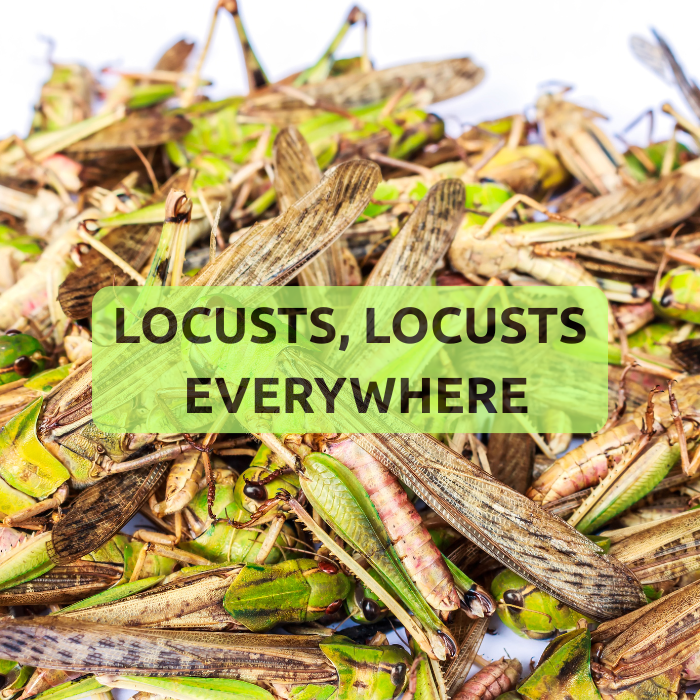
The Eighth Plague: Locusts
1Then 𐤉𐤄𐤅𐤄 said to Moshe, “Go to Pharaoh, for I have hardened his heart and the hearts of his officials, that I may perform these miraculous signs of Mine among them, 2 and that you may tell your children and grandchildren how severely I dealt with the Mitsrites when I performed miraculous signs among them, so that all of you may know that I am 𐤉𐤄𐤅𐤄.”
3 So Moshe and Aharon went to Pharaoh and told him, “This is what 𐤉𐤄𐤅𐤄, the Alahym of the Hebrews, says: ‘How long will you refuse to humble yourself before Me? Let My people go, so that they may worship Me. 4 But if you refuse to let My people go, I will bring locusts into your territory tomorrow. 5 They will cover the face of the land so that no one can see it. They will devour whatever is left after the hail and eat every tree that grows in your fields. 6 They will fill your houses and the houses of all your officials and every Mitsrite—something neither your fathers nor your grandfathers have seen since the day they came into this land.’ ”
Then Moshe turned and left Pharaoh’s presence.
7 Pharaoh’s officials asked him, “How long will this man be a snare to us? Let the people go, so that they may worship 𐤉𐤄𐤅𐤄 their Alahym. Do you not yet realize that Mitsrayim lies in ruins?”
8 So Moshe and Aharon were brought back to Pharaoh. “Go, worship 𐤉𐤄𐤅𐤄 your Alahym,” he said. “But who exactly will be going?”
9 “We will go with our young and old,” Moshe replied. “We will go with our sons and daughters, and with our flocks and herds, for we must hold a feast to 𐤉𐤄𐤅𐤄.”
10 Then Pharaoh told them, “May 𐤉𐤄𐤅𐤄 be with you if I ever let you go with your little ones. Clearly you are bent on evil. 11 No, only the men may go and worship 𐤉𐤄𐤅𐤄, since that is what you have been requesting.” And Moshe and Aharon were driven from Pharaoh’s presence.
12 Then 𐤉𐤄𐤅𐤄 said to Moshe, “Stretch out your hand over the land of Mitsrayim, so that the locusts may swarm over it and devour every plant in the land—everything that the hail has left behind.”
13 So Moshe stretched out his staff over the land of Mitsrayim, and throughout that day and night 𐤉𐤄𐤅𐤄 sent an east wind across the land. By morning the east wind had brought the locusts.
14 The locusts swarmed across the land and settled over the entire territory of Mitsrayim. Never before had there been so many locusts, and never again will there be. 15 They covered the face of all the land until it was black, and they consumed all the plants on the ground and all the fruit on the trees that the hail had left behind. Nothing green was left on any tree or plant in all the land of Mitsrayim.
16 Pharaoh quickly summoned Moshe and Aharon and said, “I have sinned against 𐤉𐤄𐤅𐤄 your Alahym and against you. 17 Now please forgive my sin once more and appeal to 𐤉𐤄𐤅𐤄 your Alahym, that He may remove this death from me.”
18 So Moshe left Pharaoh’s presence and appealed to 𐤉𐤄𐤅𐤄 – YAHUAH. 19 And 𐤉𐤄𐤅𐤄 changed the wind to a very strong west wind that carried off the locusts and blew them into the Red Sea. Not a single locust remained anywhere in Mitsrayim.
20 But 𐤉𐤄𐤅𐤄 hardened Pharaoh’s heart, and he would not let the Yasharalites go.
The Ninth Plague: Darkness
21 Then 𐤉𐤄𐤅𐤄 said to Moshe, “Stretch out your hand toward heaven, so that darkness may spread over the land of Mitsrayim—a palpable darkness.”
22 So Moshe stretched out his hand toward heaven, and total darkness covered all the land of Mitsrayim for three days. 23 No one could see anyone else, and for three days no one left his place. Yet all the Yasharalites had light in their dwellings.
24 Then Pharaoh summoned Moshe and said, “Go, worship 𐤉𐤄𐤅𐤄. Even your little ones may go with you; only your flocks and herds must stay behind.”
25 But Moshe replied, “You must also provide us with sacrifices and burnt offerings to present to 𐤉𐤄𐤅𐤄 our Alahym. 26 Even our livestock must go with us; not a hoof will be left behind, for we will need some of them to worship 𐤉𐤄𐤅𐤄 our Alahym, and we will not know how we are to worship 𐤉𐤄𐤅𐤄 until we arrive.”
27 But 𐤉𐤄𐤅𐤄 hardened Pharaoh’s heart, and he was unwilling to let them go. 28 “Depart from me!” Pharaoh said to Moshe. “Make sure you never see my face again, for on the day you see my face, you will die.”
29 “As you say,” Moshe replied, “I will never see your face again.”
Shemoth (Exodus) Chapter 11
The Plague on the Firstborn Foretold
1Then 𐤉𐤄𐤅𐤄 said to Moshe, “I will bring upon Pharaoh and Mitsrayim one more plague. After that, he will allow you to leave this place. And when he lets you go, he will drive you out completely. 2 Now announce to the people that men and women alike should ask their neighbors for articles of silver and gold.”
3 And 𐤉𐤄𐤅𐤄 gave the people favor in the sight of the Mitsrites. Moreover, Moshe himself was highly regarded in Mitsrayim by Pharaoh’s officials and by the people.
4 So Moshe declared, “This is what 𐤉𐤄𐤅𐤄 says: ‘About midnight I will go throughout Mitsrayim, 5 and every firstborn son in the land of Mitsrayim will die, from the firstborn of Pharaoh who sits on his throne, to the firstborn of the servant girl behind the hand mill, as well as the firstborn of all the cattle. 6 Then a great cry will go out over all the land of Mitsrayim. Such an outcry has never been heard before and will never be heard again. 7 But among all the Yasharalites, not even a dog will snarl at man or beast.’
Then you will know that 𐤉𐤄𐤅𐤄 makes a distinction between Mitsrayim and Yasharal. 8 And all these officials of yours will come and bow before me, saying, ‘Go, you and all the people who follow you!’ After that, I will depart.”
And hot with anger, Moshe left Pharaoh’s presence.
9 𐤉𐤄𐤅𐤄 said to Moshe, “Pharaoh will not listen to you, so that My wonders may be multiplied in the land of Mitsrayim.”
10 Moshe and Aharon did all these wonders before Pharaoh, but 𐤉𐤄𐤅𐤄 hardened Pharaoh’s heart so that he would not let the Yasharalites go out of his land.
Shemoth (Exodus) Chapter 12
The First Passover (Numbers 9:1–14)
1Now 𐤉𐤄𐤅𐤄 said to Moshe and Aharon in the land of Mitsrayim, 2 “This month is the beginning of months for you; it shall be the first month of your year.
3 Tell the whole congregation of Yasharal that on the tenth day of this month each man must select a lamb for his family, one per household. 4 If the household is too small for a whole lamb, they are to share with the nearest neighbor based on the number of people, and apportion the lamb accordingly.
5 Your lamb must be an unblemished year-old male, and you may take it from the sheep or the goats. 6 You must keep it until the fourteenth day of the month, when the whole assembly of the congregation of Yasharal will slaughter the animals at twilight. 7 They are to take some of the blood and put it on the sides and tops of the doorframes of the houses where they eat the lambs.
8 They are to eat the meat that night, roasted over the fire, along with unleavened bread and bitter herbs.
9 Do not eat any of the meat raw or cooked in boiling water, but only roasted over the fire—its head and legs and inner parts. 10 Do not leave any of it until morning; before the morning you must burn up any part that is left over.
11 This is how you are to eat it: You must be fully dressed for travel, with your sandals on your feet and your staff in your hand. You are to eat in haste; it is 𐤉𐤄𐤅𐤄’s Passover.
12 On that night I will pass through the land of Mitsrayim and strike down every firstborn male, both man and beast, and I will execute judgment against all the gods of Mitsrayim. I am 𐤉𐤄𐤅𐤄 – YAHUAH. 13 The blood on the houses where you are staying will be a sign; when I see the blood, I will pass over you. No plague will fall on you to destroy you when I strike the land of Mitsrayim.
The Feast of Unleavened Bread (Leviticus 23:4–8 ; Numbers 28:16–25 ; Deuteronomy 16:1–8)
14 And this day will be a memorial for you, and you are to celebrate it as a feast to 𐤉𐤄𐤅𐤄, as a permanent statute for the generations to come. 15 For seven days you must eat unleavened bread. On the first day you are to remove the leaven from your houses. Whoever eats anything leavened from the first day through the seventh must be cut off from Yasharal.
16 On the first day you are to hold a set apart assembly, and another on the seventh day. You must not do any work on those days, except to prepare the meals—that is all you may do.
17 So you are to keep the Feast of Unleavened Bread, for on this very day I brought your divisions out of the land of Mitsrayim. You must keep this day as a permanent statute for the generations to come. 18 In the first month, you are to eat unleavened bread, from the evening of the fourteenth day until the evening of the twenty-first day. 19 For seven days there must be no leaven found in your houses. If anyone eats something leavened, that person, whether a foreigner or native of the land, must be cut off from the congregation of Yasharal. 20 You are not to eat anything leavened; eat unleavened bread in all your homes.”
21 Then Moshe summoned all the elders of Yasharal and told them, “Go at once and select for yourselves a lamb for each family, and slaughter the Passover lamb. 22 Take a cluster of hyssop, dip it into the blood in the basin, and brush the blood on the top and sides of the doorframe. None of you shall go out the door of his house until morning.
23 When 𐤉𐤄𐤅𐤄 passes through to strike down the Mitsrites, He will see the blood on the top and sides of the doorframe and will pass over that doorway; so He will not allow the destroyer to enter your houses and strike you down.
24 And you are to keep this command as a permanent statute for you and your descendants. 25 When you enter the land that 𐤉𐤄𐤅𐤄 will give you as He promised, you are to keep this service.
26 When your children ask you, ‘What does this service mean to you?’ 27 you are to reply, ‘It is the Passover sacrifice to 𐤉𐤄𐤅𐤄, who passed over the houses of the Yasharalites in Mitsrayim when He struck down the Mitsrites and spared our homes.’ ”
Then the people bowed down and worshiped. 28 And the Yasharalites went and did just what 𐤉𐤄𐤅𐤄 had commanded Moshe and Aharon.
The Tenth Plague: Death of the Firstborn
29 Now at midnight 𐤉𐤄𐤅𐤄 struck down every firstborn male in the land of Mitsrayim, from the firstborn of Pharaoh, who sat on his throne, to the firstborn of the prisoner in the dungeon, as well as all the firstborn among the livestock.
30 During the night Pharaoh got up—he and all his officials and all the Mitsrites—and there was loud wailing in Mitsrayim; for there was no house without someone dead.
The Exodus Begins
31 Then Pharaoh summoned Moshe and Aharon by night and said, “Get up, leave my people, both you and the Yasharalites! Go, worship 𐤉𐤄𐤅𐤄 as you have requested. 32 Take your flocks and herds as well, just as you have said, and depart! And bless me also.”
33 And in order to send them out of the land quickly, the Mitsrites urged the people on. “For otherwise,” they said, “we are all going to die!” 34 So the people took their dough before it was leavened, carrying it on their shoulders in kneading bowls wrapped in clothing.
35 Furthermore, the Yasharalites acted on Moshe’s word and asked the Mitsrites for articles of silver and gold, and for clothing. 36 And 𐤉𐤄𐤅𐤄 gave the people such favor in the sight of the Mitsrites that they granted their request. In this way they plundered the Mitsrites.
37 The Yasharalites journeyed from Ra‛meses to Sukkoth with about 600,000 men on foot, besides women and children. 38 And a mixed multitude also went up with them, along with great droves of livestock, both flocks and herds.
39 Since their dough had no leaven, the people baked what they had brought out of Mitsrayim into unleavened loaves. For when they had been driven out of Mitsrayim, they could not delay and had not prepared any provisions for themselves.
40 Now the duration of the Yasharalites’ stay in Mitsrayim was 430 years. 41 At the end of the 430 years, to the very day, all 𐤉𐤄𐤅𐤄’s divisions went out of the land of Mitsrayim. 42 Because 𐤉𐤄𐤅𐤄 kept watch that night to bring them out of the land of Mitsrayim, this same night is to be a night of watches to 𐤉𐤄𐤅𐤄, to be observed by all the Yasharalites for the generations to come.
Instructions for the Passover
43 And 𐤉𐤄𐤅𐤄 said to Moshe and Aharon, “This is the statute of the Passover: No foreigner is to eat of it. 44 But any slave who has been purchased may eat of it, after you have circumcised him. 45 A temporary resident or hired hand shall not eat the Passover.
46 It must be eaten inside one house. You are not to take any of the meat outside the house, and you may not break any of the bones.
47 The whole congregation of Yasharal must celebrate it. 48 If a foreigner resides with you and wants to celebrate 𐤉𐤄𐤅𐤄’s Passover, all the males in the household must be circumcised; then he may come near to celebrate it, and he shall be like a native of the land. But no uncircumcised man may eat of it. 49 The same law shall apply to both the native and the foreigner who resides among you.”
50 Then all the Yasharalites did this—they did just as 𐤉𐤄𐤅𐤄 had commanded Moshe and Aharon. 51 And on that very day, 𐤉𐤄𐤅𐤄 brought the Yasharalites out of the land of Mitsrayim by their divisions.
Shemoth (Exodus) Chapter 13
The Dedication of the Firstborn (Deuteronomy 15:19-23)
1Then 𐤉𐤄𐤅𐤄 said to Moshe, 2 “Set Apart unto Me every firstborn male. The firstborn from every womb among the Yasharalites belongs to Me, both of man and beast.”
3 So Moshe told the people, “Remember this day, the day you came out of Mitsrayim, out of the house of slavery; for 𐤉𐤄𐤅𐤄 brought you out of it by the strength of His hand. And nothing leavened shall be eaten.
4 Today, in the month of Abib, you are leaving. 5 And when 𐤉𐤄𐤅𐤄 brings you into the land of the Kena‛anites, and the Ḥittites, and the Amorites, and the Ḥiwwites, and the Yeḇusites—the land He swore to your fathers that He would give you, a land flowing with milk and honey—you shall keep this service in this month.
6 For seven days you are to eat unleavened bread, and on the seventh day there shall be a feast to 𐤉𐤄𐤅𐤄 – YAHUAH. 7 Unleavened bread shall be eaten during those seven days. Nothing leavened may be found among you, nor shall leaven be found anywhere within your borders.
8 And on that day you are to explain to your son, ‘This is because of what 𐤉𐤄𐤅𐤄 did for me when I came out of Mitsrayim.’ 9 It shall be a sign for you on your hand and a reminder on your forehead that the Law of 𐤉𐤄𐤅𐤄 is to be on your lips. For with a mighty hand 𐤉𐤄𐤅𐤄 brought you out of Mitsrayim. 10 Therefore you shall keep this statute at the appointed time year after year.
11 And after 𐤉𐤄𐤅𐤄 brings you into the land of the Kena‛anites and gives it to you, as He swore to you and your fathers, 12 you are to present to 𐤉𐤄𐤅𐤄 the firstborn male of every womb. All the firstborn males of your livestock belong to 𐤉𐤄𐤅𐤄 – YAHUAH. 13 You must redeem every firstborn donkey with a lamb, and if you do not redeem it, you are to break its neck. And every firstborn of your sons you must redeem.
14 In the future, when your son asks you, ‘What does this mean?’ you are to tell him, ‘With a mighty hand 𐤉𐤄𐤅𐤄 brought us out of Mitsrayim, out of the house of slavery. 15 And when Pharaoh stubbornly refused to let us go, 𐤉𐤄𐤅𐤄 killed every firstborn in the land of Mitsrayim, both of man and beast. This is why I sacrifice to 𐤉𐤄𐤅𐤄 the firstborn male of every womb, but I redeem all the firstborn of my sons.’ 16 So it shall serve as a sign on your hand and a symbol on your forehead, for with a mighty hand 𐤉𐤄𐤅𐤄 brought us out of Mitsrayim.”
| Yirmeyahu (Jeremiah) 46:13-28 |
Yirmeyahu (Jeremiah) Chapter 46
13 This is the word that 𐤉𐤄𐤅𐤄 spoke to Yirmeyahu the prophet about the coming of Neḇuḵaḏretstsar sovereign of Baḇel to strike the land of Mitsrayim:
14 “Announce it in Mitsrayim, and proclaim it in Miḡdol;
proclaim it in Memphis (Noph) and Taḥpanḥes:
‘Take your positions and prepare yourself,
for the sword devours those around you.’
15 Why have your warriors been laid low?
They cannot stand, for 𐤉𐤄𐤅𐤄 has thrust them down.
16 They continue to stumble;
indeed, they have fallen over one another.
They say, ‘Get up! Let us return to our people
and to the land of our birth,
away from the sword of the oppressor.’
17 There they will cry out:
‘Pharaoh king of Mitsrayim was all noise;
he has let the appointed time pass him by.’
18 As surely as I live, declares the Sovereign,
whose name is 𐤉𐤄𐤅𐤄 Tsabaut,
there will come one who is like Taḇor among the mountains
and like Karmel by the sea.
19 Pack your bags for exile,
O daughter dwelling in Mitsrayim!
For Memphis [Noph] will be laid waste,
destroyed and uninhabited.
20 Mitsrayim is a beautiful heifer,
but a gadfly from the north is coming against her.
21 Even the mercenaries among her
are like fattened calves.
They too will turn back;
together they will flee, they will not stand their ground,
for the day of calamity is coming upon them—
the time of their punishment.
22 Mitsrayim will hiss like a fleeing serpent,
for the enemy will advance in force;
with axes they will come against her
like woodsmen cutting down trees.
23 They will chop down her forest, declares 𐤉𐤄𐤅𐤄,
dense though it may be,
for they are more numerous than locusts;
they cannot be counted.
24 The Daughter of Mitsrayim will be put to shame;
she will be delivered into the hands of the people of the north.”
25 𐤉𐤄𐤅𐤄 Tsabaut, the Alahym of Yasharal, says: “Behold, I am about to punish Amon god of Thebes, along with Pharaoh, Mitsrayim with her idols and sovereigns, and those who trust in Pharaoh. 26 I will deliver them into the hands of those who seek their lives—of Neḇuḵaḏretstsar sovereign of Baḇel and his officers. But after this, Mitsrayim will be inhabited as in days of old, declares 𐤉𐤄𐤅𐤄.
27 But you, O Ya‛aqoḇ My servant, do not be afraid,
and do not be dismayed, O Yasharal.
For I will surely save you out of a distant place,
your descendants from the land of
their captivity!
Ya‛aqoḇ will return to quiet and ease,
with no one to make him afraid.
28 And you, My servant Ya‛aqoḇ, do not be afraid,
declares 𐤉𐤄𐤅𐤄, for I am with you.
Though I will completely destroy all the nations to which I have banished you,
I will not completely destroy you.
Yet I will discipline you justly,
and will by no means leave you unpunished.”
| Romiyim (Romans) 9:14-29 |
Romiyim (Romans) Chapter 9
14 What then shall we say? Is Alahym unjust? Certainly not! 15 For He says to Moshe:
“I will have mercy on whom I have mercy,
and I will have compassion on whom I have compassion.”
16 So then, it does not depend on man’s desire or effort, but on Alahym’s mercy. 17 For the Scripture says to Pharaoh: “I raised you up for this very purpose, that I might display My power in you, and that My name might be proclaimed in all the earth.” 18 Therefore Alahym has mercy on whom He wants to have mercy, and He hardens whom He wants to harden.
19 One of you will say to me, “Then why does Alahym still find fault? For who can resist His will?” 20 But who are you, O man, to talk back to Alahym? Shall what is formed say to Him who formed it, “Why did You make me like this?” 21 Does not the potter have the right to make from the same lump of clay one vessel for honor and another for dishonor?
22 What if Alahym, intending to show His wrath and make His power known, bore with great patience the vessels of His wrath, prepared for destruction? 23 What if He did this to make the riches of His esteem known to the vessels of His mercy, whom He prepared in advance for esteem— 24 including us, whom He has called not only from the Yahudim, but also from the nations? 25 As He says in Hoshěa:
“I will call them ‘My People’ who are not My people,
and I will call her ‘My Beloved’ who is not My beloved,”
26 and,
“It will happen that in the very place where it was said to them,
‘You are not My people,’
they will be called
‘sons of the living Alahym.’ ”
27 YashaYahu cries out concerning Yasharal:
“Though the number of the Yasharalites is like the sand of the sea,
only the remnant will be saved.
28 For the Master will carry out His sentence on the earth
thoroughly and decisively.”
29 It is just as YashaYahu foretold:
“Unless the 𐤉𐤄𐤅𐤄 Tsabaut had left us descendants,
we would have become like Seḏom,
we would have resembled Amorah.”